
No Perry 72-Hour Feed
Official SEORJ and Perry Sheriff channels do not provide a rolling three-day release list. The available jail page is a current five-county roster. It displays people in regional custody at the time of the rendering and includes a run timestamp, but no release date, release reason, released filter, or archive. Its title, “New Inmate Roster,” refers to bookings, not a list of recent departures.
A wider lookback is still useful when the event may have occurred before a weekend, over a holiday, or while a court portal was delayed. It simply must be built from records, not from an invented feed. The three-day task is to reconcile jail, court, notification, and receiving-custody evidence for the whole period.
Search results from a similarly named county can be misleading. An apparent ISOMS 72-hour portal belongs to Perry County, Tennessee, as shown by Tennessee place names in its records. It must not be used for Perry County, Ohio. Unofficial arrest and photo collections also do not establish that a person left custody during the chosen window.
Check Perry 72-Hour Releases
Work from a defined start and end time. The public sources do not offer a three-day filter, so keep notes about when each source was checked and what it actually stated. SEORJ is regional. Use the arresting agency and court to determine whether the booking belongs to Perry County before following the case.
- Check the current SEORJ roster and record the run time, Jail ID, book date, court, and arresting agency for the intended episode.
- Review the Perry Municipal Court docket for misdemeanors or Common Pleas docket for felonies across the whole three-day span.
- Look for bond, recognizance, dismissal, sentence completion, commitment, or transfer language, then read the filed order where available.
- Search Ohio VINE for a release or transfer event from the matching source agency.
- Call SEORJ at 740-753-4060 and request its actual release entry when the public sources do not settle the event.
- Search ODRC when a Perry felony disposition indicates transfer to state prison.
A same-day question can use the narrower Released Last 24 Hours workflow. The three-day approach differs because it checks multiple court and custody events over a longer period rather than trying to prove one day's release from the current roster.
Use the Perry Municipal Court search for countywide misdemeanor and traffic matters. Common Pleas handles felony matters. Court entries supply legal context, but they can lag and do not record the exact moment SEORJ completed a physical release. When the event time controls whether it belongs in the 72-hour range, request the jail entry.
Perry Three-Day Record Fields
No official list supplies these fields as one record set. The current roster gives booking-side clues, and a direct release record must provide the departure-side proof. The comparison prevents current custody data from being misread as a historical release result.
| Field | Role in a 72-hour check |
|---|---|
| Jail ID and book date | Match the precise SEORJ episode |
| Arresting agency and court | Separate a Perry matter from other member counties |
| Current disposition and bail | Context only; neither proves physical departure |
| Actual release date and time | Confirms whether the event falls inside the three-day range |
| Release reason or authority | Distinguishes bond, completion, dismissal, transfer, or another basis |
| Destination or receiving agency | Shows whether custody continued after leaving SEORJ, when recorded |
Ask for a code legend if the jail uses abbreviated release reasons. A docket entry can support the legal cause, but the jail's entry is the better source for the physical end of its custody.
The official current roster source shows the limits of the available public interface.
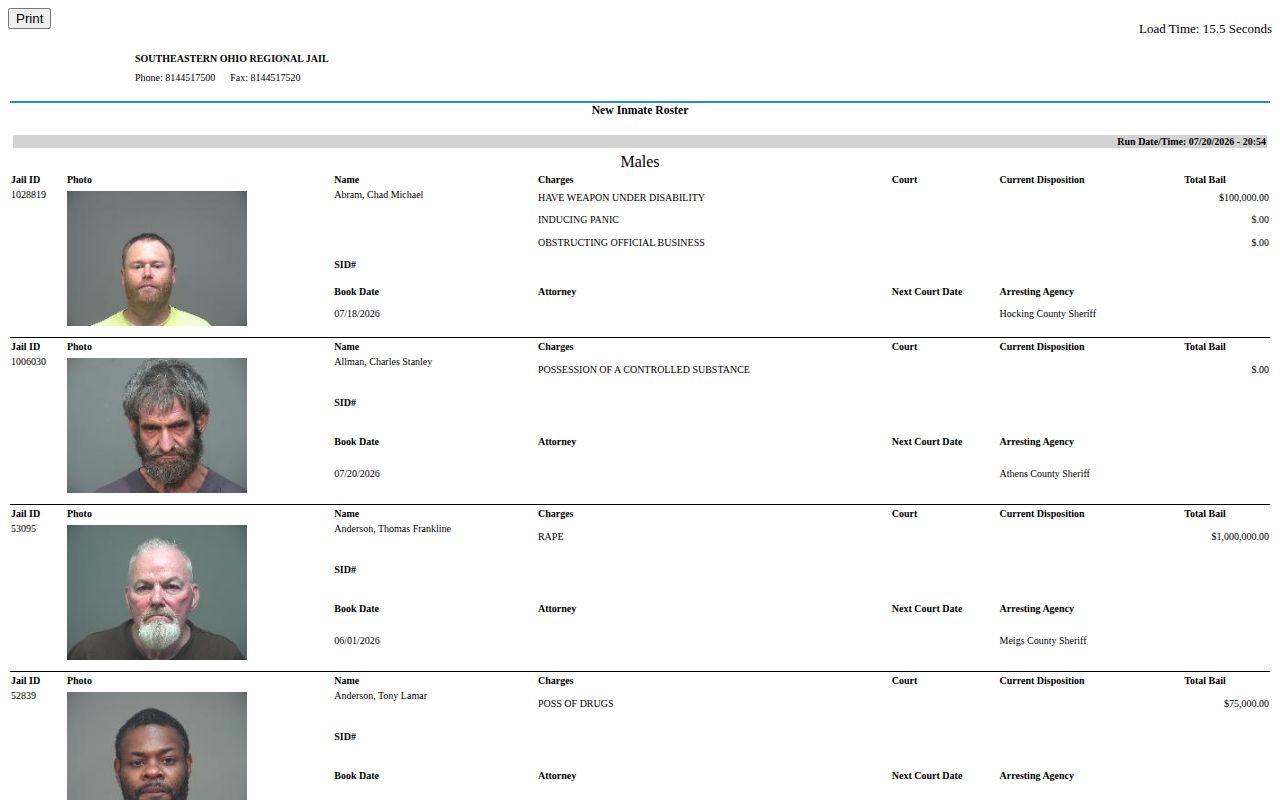
The captured roster has current booking fields and a run time, not a rolling three-day release list.
Perry Weekend Release Timing
No Perry-specific early-weekend release rule, holiday processing schedule, or public exit-time policy was verified. Do not move a date forward or backward based on a general assumption. Court action, identity checks, another hold, and jail processing can make the legal release authority and physical departure occur at different times.
Perry Municipal Court explicitly warns that its online records may lag by at least 24 hours and sometimes longer. A Monday portal update may describe an earlier weekend action. Conversely, a posted bond entry may appear while the person remains in jail pending processing or another hold. The three-day review should compare the actual docket timestamp, filed order, VINE event, and SEORJ release entry.
Use event time and posting time as separate columns in the review. A court entry posted on the third day may refer to an order signed on the first day. A VINE notice may arrive after the jail processed the event. The SEORJ release record should be requested for the actual departure time, while the filed court order explains the legal authority. Keeping both dates prevents a late posting from being counted as a new release.
For a named person whose timeline crosses systems, use the Perry release search and record process. It distinguishes regional jail departure, ODRC admission, state prison release, and federal custody.
Perry Three-Day Request Fallback
Ask SEORJ for the existing release record tied to the exact booking. Include the name, identifying birth information when needed, approximate dates, Jail ID, arresting agency, and court case number. Request actual release date and time, type or authority, destination or receiving agency if recorded, and detainer disposition. No official local fee, turnaround, or retention term was found.
The Perry Sheriff report-request form can serve as a secondary path, but it is not labeled as a jail-release form. Ask whether SEORJ is the custodian and request redirection when appropriate. Under Ohio's Public Records Act, a request should identify existing records rather than require an office to conduct research or create a new three-day list.
VINE may report release or transfer from a supplying agency. ODRC may show admission after a prison commitment and later state supervision or release. A current ODRC record cannot replace the SEORJ release sheet for a county-only episode.
The VINELink search should be matched by person, source agency, and custody episode. A reported release means that supplier reported departure from its custody, not that every hold ended. When state transfer is plausible, the ODRC Offender Search can show an admission, incarceration, later release, or APA supervision tied to an Ohio prison case.
Keep a simple source log for the three-day range: source name, access time, status text, identifying record number, and event date. That helps reconcile a late court posting with an earlier jail event without claiming an official feed exists.
Phrase the request around one booking rather than asking SEORJ to create a custom 72-hour report. Ask for the existing booking and release record, including the actual release time, authority, receiving agency, and detainer disposition if recorded. A narrow request is easier to identify and preserves the distinction between an existing release entry and a list the jail does not publish. If an older entry no longer exists, ask for the applicable retention schedule instead of assuming a fixed archive period.
Perry Regional Roster Quirks
The SEORJ roster combines five participating counties. Court and arresting-agency fields are therefore essential. A person booked by a non-Perry agency can appear on the same screen, and an unofficial page labeled “Perry County Jail” should not be treated as a separate authoritative source.
The 2019 Perry systems report said the booking roster was shared with the sheriff, VA, and ICE at that time. That historical practice does not create a public release archive, prove current sharing, or establish ICE custody for any person. No verified SEORJ ICE contract was found.
Note: A Perry court or arresting agency connects the regional booking to Perry County; the jail name alone does not.
Perry Release Versus Transfer
A disappearance from SEORJ only proves that the person is no longer displayed on the current roster. Bond or recognizance may place the person in the community while the case continues. Time served can end one term. A transfer to ODRC, another county, a federal agency, or immigration custody means confinement continued under a different custodian.
Use precise language after comparing sources. “SEORJ reported release” is different from “SEORJ transferred the person to ODRC.” VINE also distinguishes some custody events by supplying agency. If ODRC shows a matching admission and Perry commitment, the state record supports transfer rather than a community release from the regional jail.
The broader three-day span is useful for spotting that sequence. It does not weaken the need for an actual release date, reason, and destination.