
Perry Parole Versus Probation
Parole and probation both permit a person to live in the community under rules, but the legal source and supervising office differ. Ohio parole follows release from a state prison and is administered by the Ohio Adult Parole Authority. Post-release control is another form of state supervision after prison. Perry Municipal Court probation comes from a local court sentence and is handled through the court's probation staff. A person released from the Southeastern Ohio Regional Jail on a misdemeanor case may report locally and never enter the Ohio prison system.
The first task is to identify the court and sentence. Perry Common Pleas handles felony matters, while Municipal Court handles countywide misdemeanor and traffic cases. A prison commitment can lead to an Ohio Department of Rehabilitation and Correction record. A municipal probation order usually stays in the local court file. The agency named in the most recent order controls reporting instructions.
Judicial release adds another path. It is a court-ordered move from prison into community supervision, so both the Common Pleas order and state corrections detail may matter. “APA Supervision” can encompass parole, post-release control, and related state supervision. It should not be translated into local probation without reading the sentence source. In the other direction, a Perry probationer may have no ODRC result at all because the person was never committed to state prison.
| Point | State parole or control | Perry probation |
|---|---|---|
| Source | Release from an Ohio prison or judicial release | Sentence or order from a local court |
| Agency | Ohio Adult Parole Authority | Perry Municipal Court probation staff |
| Starting record | ODRC Offender Search detail | Municipal Court docket and probation office |
| Key proof | Status, supervision start, APA office, conditions | Sentencing entry, probation order, court confirmation |
- Parole
- Conditional community release from a prison term under APA authority.
- Probation
- Court-ordered community supervision, often imposed instead of or after local jail time.
- Post-release control
- State supervision that follows certain Ohio prison terms.
- Discharge
- The formal end of the applicable supervision period.
Check Perry Post-Release Supervision
The ODRC Offender Search is the official starting point for state parole, post-release control, judicial release, and reported violator-at-large status. It accepts a name or offender number. County of Commitment=Perry finds records tied to a Perry sentence. Residential County=Perry instead finds certain APA or violator records with a last recorded Perry residence. Those filters answer different questions and should not be treated as substitutes.
Open the person detail rather than relying on the result label. Compare the offender number and birth information, then read status, supervision start, supervision period, APA office, conditions, and notes when shown. ODRC warns that an offense list may be incomplete and that supervision may concern an earlier offense. A residence field can lag and is not a live location.
Status labels require careful reading. “Incarcerated” means the person remains in Ohio prison custody even if a future release-related date appears. “APA Supervision” indicates Department supervision in the community, but the detail must show whether parole, post-release control, or another state arrangement applies. “Violator at Large” reports an alleged absconding status under APA authority. “Judicial release” reflects a court-ordered move from prison into community supervision. None of these labels establishes Perry Municipal Court probation, which must be verified in the local sentence and docket.
- Identify whether the sentence came from Perry Municipal Court, Perry Common Pleas, or an Ohio prison case.
- For state supervision, search ODRC by exact offender number when known, or by surname and first name.
- Use County of Commitment=Perry for a Perry sentence. Use Residential County=Perry only for the recorded supervision residence.
- Open the detail and record the status, supervision dates, and named APA office.
- For local probation, read the sentencing docket and confirm current instructions with Perry Municipal Court probation.
- Resolve conflicts through the supervising office shown in the current record.
Note: Release from jail or prison and discharge from supervision are separate events, so both custody and supervision records may be needed.
Perry Probation Office Details
Perry Municipal Court publishes a local probation line and identifies staff roles that include chief probation, intensive probation, and drug-court probation. This is local court supervision. It is not the same agency as the Ohio APA. The court's contact is appropriate for a Municipal Court probation order, a reporting question tied to that case, or confirmation of the current court record.
Perry County Municipal Court Probation
105 N. Main St.P.O. Box 207
New Lexington, OH 43764
Probation: 740-342-5536
Court: 740-342-3156
Hours: Monday through Friday, 8:00 a.m. to 4:00 p.m., closed noon to 1:00 p.m.
No authoritative static source identified one physical APA field office for every Perry County case. For state parole or post-release control, use the office named on the individual's ODRC detail. That record is more reliable than guessing from geography, since supervision assignment can depend on the person and case.
When an ODRC detail names an office, record the office label along with the offender number and date checked. Conditions and assignments can change. A directory address copied from an older record may route the question to the wrong unit. For a Municipal Court case, use the local probation line, but keep the case number available so staff can distinguish people with similar names and identify the controlling order.
The two ODRC county filters also need different treatment. County of Commitment identifies the sentencing county reported for the state case. Residential County applies to APA supervision or violator records and reflects the last recorded residence. A Perry commitment does not prove that the person now lives in Perry, while a Perry residential result does not prove that the conviction arose there. Record both fields when they matter and use the docket number to connect the supervision record to the right sentence.
Perry Supervision Violation Status
Conditions are enforceable rules set by the court or APA. They may address reporting, travel, treatment, or other case-specific duties. The controlling terms are in the order and supervising-agency record. A missed report or alleged violation can lead to a warrant, hold, hearing, or return to custody, but it does not prove a new conviction.
An absconder is a person alleged to have stopped complying with supervision or whose whereabouts are not known to the agency. ODRC's Parole Violators at Large listing may show a photograph, name, offender number, date declared at large, and offenses. The official page warns the public not to apprehend anyone and to contact law enforcement. A last recorded residence is not a current location, and only law enforcement can confirm warrant status through its systems.
The official ODRC violator page shows how the public list is framed. Review the source page before interpreting a match.
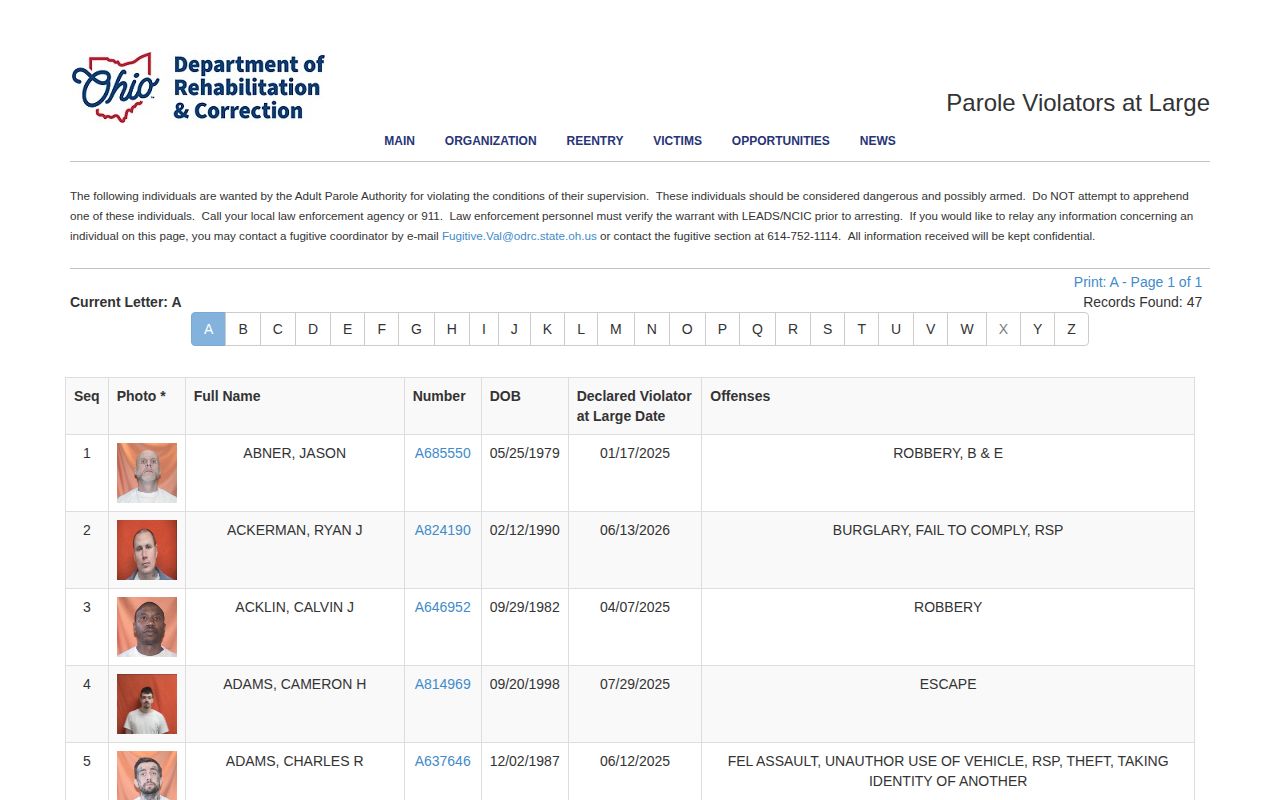
The image documents the statewide status tool, not a Perry-only warrant list. Match the offender number and contact the listed authority for verification.
Perry Release Reentry Leads
A 2019 Perry systems-mapping report described referral paths involving the Six County Board and Allwell, Perry Behavioral Health, STAR Community Justice Center, and Hopewell-related jail reentry planning. The same report said the Perry Reentry Alliance was inactive at that time. These details are a dated snapshot, not proof that a program now accepts referrals or serves each person.
Current support should be checked with the supervising officer, sentencing court, or provider. Eligibility, service area, and referral rules may have changed. A local probation officer may use different resources than an APA officer handling a person released from prison. The distinction matters because supervision rules and approved services can be tied to the case.
Note: Historical program names are navigation leads only; current intake, eligibility, and referral terms must be confirmed with each provider.
Perry Supervision Discharge Records
Supervision ends through a formal discharge, expiration, court order, or other action under the controlling sentence. Time passing alone is not enough to confirm it. For APA supervision, compare the current ODRC status with the supervision start and period, then seek the relevant APA action when needed. Ohio law makes specified APA minutes, actions, findings, recommendations, determinations, and orders public records under ORC 5149.02, subject to other law.
For local probation, read the Perry court docket for a termination, completion, violation, or extension entry. A case can remain visible after supervision ends, and a closed custody event does not itself establish a probation discharge. When the online docket is unclear, request the filed order from the clerk or call the probation office tied to the case.
Ohio VINE reports custody and specified ODRC events, but it is not a complete supervision-history archive. A jail release alert does not establish that probation ended. Likewise, a release from parole notice applies to the state supervision event it identifies, not every local court obligation. Match each notice to the agency and case before drawing a conclusion.
When a public detail does not resolve the end date, ask for the existing order or action rather than a new explanation. The clerk can supply a filed local termination order when it is public. For state supervision, an APA action or other existing record may document the discharge. Ohio public-record law does not make every probation or parole detail open, and statutory protections may restrict parts of supervision proceedings. A redaction or limited response therefore should not be converted into a claim that no supervision existed.
The broader sequence is: custody release, community supervision, then formal discharge. Perry County release verification for the first event is covered on the released-inmate search and records page. Keep each record tied to the agency that created it.