
Perry County Release Records
An adult arrested in Perry County is normally held at the Southeastern Ohio Regional Jail, or SEORJ, in Nelsonville. The regional jail serves Athens, Hocking, Morgan, Perry, and Vinton Counties. Its New Inmate Roster shows people in current displayed custody, not a history of Perry County released inmates. A person who vanishes from that list may have gone home, but the same change can mark a transfer to the Ohio Department of Rehabilitation and Correction, another jail, federal custody, or another agency.
A release record answers the narrow custodial question: when and under what authority did SEORJ stop holding this person? The court file answers a related legal question. Municipal Court handles misdemeanor and traffic matters, while Common Pleas handles felonies. Ohio VINE may report the custody event. The correct account often comes from all three sources. None should be stretched beyond what it records.
- Release
- Departure from one custodian, either to the community or another agency.
- Discharge
- The formal end of a custody or supervision status.
- Time served
- Completion of the credited jail term in that matter.
- Detainer
- A hold or request that may send the person to another custodian.
Perry County Release Types
Words such as “released” and “disposition” are not enough by themselves. A bond release ends physical custody for the pending charge, subject to the case and bond terms. It does not clear the charge. A dismissal may support release when no other legal basis for custody remains. A transfer ends SEORJ custody but continues confinement elsewhere. These differences decide where a Perry County released inmate should be checked next.
| Release type | Meaning | Next record |
|---|---|---|
| Bond or recognizance | Pretrial release while the case continues | Perry court docket and SEORJ release entry |
| Time served | Credited custodial term was completed | Sentencing entry and jail release record |
| Dismissal or court order | The named charge or order no longer supports custody | Filed judgment plus physical release confirmation |
| ODRC transfer | Regional jail custody ended, state prison custody began | ODRC admission and offender detail |
| Parole or judicial release | Prison ended and community supervision may begin | ODRC status, APA office, and court order |
| Other agency hold | One custodian released the person to another | Receiving agency record and detainer details |
Can “not on the roster” prove release? No. It proves only that the current roster does not display the person at that moment. The release entry, reported VINE event, court action, or receiving-system record supplies the missing reason.
Perry County Release Record Fields
A sound request connects the release side of the record to one booking episode. Name, Jail ID, arresting agency, booking date, court, and case number help SEORJ identify the right event among five member counties. Asking for a booking sheet alone may omit the key release fields. Ask for the booking sheet plus its release section and any code legend used to read the disposition.
| Field | What it shows |
|---|---|
| Actual release date and time | When the jail ended its physical custody |
| Release reason or authority | Bond, sentence served, dismissal, order, transfer, or another coded basis |
| Jail ID and booking date | The exact regional-jail episode |
| Arresting agency and court | Whether the record relates to the intended Perry case |
| Charges, bond, and case number | The legal matter tied to custody |
| Destination or receiving agency | Whether departure was a community release or transfer |
| Detainer disposition | Whether another hold affected release |
| Booking photograph | An image linked to the episode, not proof of current status |
The inventory scopes a request. It does not assert that SEORJ stores every field, that all fields are public, or that each older record still exists. The custodian may redact exempt information and applies its approved retention schedule.
Request Perry County Release Records
SEORJ is the first office to ask because it runs the jail and its roster. The Perry County Sheriff’s Request for Report form is a useful second route, but it is built for incident reports and may not reach regional-jail data. Neither source publishes a special release-record fee, fixed completion time, or universal retention term.
- Call SEORJ at 740-753-4060 and ask who receives public-record requests for booking and release data.
- Give the full name, a distinguishing birth date if needed, approximate booking and release range, Jail ID, Perry arresting agency, and court case number.
- Request the existing booking sheet, release section, actual time, reason, authority, destination, detainer disposition, photograph, and code definitions.
- Ask for electronic copies when available. If a cost is quoted, request the fee schedule. If no record remains, ask for the approved retention schedule.
- Use the sheriff form only as a fallback, and ask that office to redirect the request if SEORJ is the actual custodian.
Ohio law asks offices to provide prompt inspection and copies within a reasonable time. It does not require staff to answer “why” questions or create a new report. A narrow request for identified existing records is more useful than a broad demand for all information about a person.
Ohio Law on Perry Releases
Ohio Revised Code 149.43 governs access to existing public records. Inspection is free, and copy charges generally reflect actual cost. An office may redact exempt material and should identify the basis for a denial. Medical information, protected supervision files, juvenile matters, and sealed or expunged records can have special limits.
Ohio has no single retention period for every jail record. Availability depends on the custodian’s approved records-retention schedule.
Sealing and expungement can change public access. A missing web result does not prove either one occurred. The record could be delayed, misindexed, offline, removed under policy, or lawfully destroyed. A filed court order is the sound source for relief in a particular case.
Perry County Release Logistics
No current official SEORJ release time, exit point, family waiting place, weekend process, property-return rule, or medication policy was found. Those gaps matter when someone expects a same-day departure. The person named in a court order may still need processing, identity checks, and review of other holds before the jail ends custody.
A 2019 Perry systems report described varied medication practices at that time. Medication brought into jail might leave with the person, while medication started in custody could result in a prescription, a short supply, or neither. That dated finding is not a current procedure. It supports one practical step: ask SEORJ directly about today’s property, medication, exit, and pickup arrangements.
Note: A court order can authorize release, but SEORJ confirms when regional-jail processing and physical departure are complete.
Travel After a Perry Release
SEORJ is in Nelsonville, outside Perry County. Perry County Transit describes curb-to-curb, demand-response shared rides on weekdays and encourages advance scheduling. It does not promise pickups from the regional jail. A family member or released person should call the transit office to ask whether the origin is eligible, what fare applies, and whether a ride is available.
Transportation should not be inferred from a projected release date. Processing can change, and transit service has its own scheduling rules. Confirm the custody event with SEORJ first, then confirm the trip directly with the carrier. No official jail shuttle or release ride was documented in the Perry research.
Perry County Bond Releases
Perry Municipal Court publishes a bond schedule for specified minor matters and identifies cases that require a judicial decision. Its rules state that an officer releases a person who gives bail or executes bond as provided by law and the schedule. The posted schedule is context, not proof that a named person has satisfied every case or hold.
A bond entry ends custody only after the jail finishes the lawful release process. The criminal case stays open, and conditions may apply. If the docket shows bond but the live SEORJ roster still shows the person, check whether the order reaches every case and whether another county, probation, parole, federal, or immigration hold exists.
Historical Perry Release Context
The 2019 Perry systems map reported that SEORJ averaged 12 bookings per day and that about 30 percent involved Perry residents. It listed a rated capacity of 230 and a workshop snapshot of 40 Perry men and 13 Perry women. These are dated planning figures, not a current population count or a count of 2026 releases.
The regional structure remains the key lesson. A roster entry needs its arresting agency and court fields to show whether it belongs to a Perry case. Regional totals cannot be treated as Perry release totals.
Search Perry County Released Inmates
The search begins with the custodian, not a name alone. An adult Perry arrest points first to SEORJ. A state-prison sentence points to ODRC. A federal judgment points to BOP, while recent immigration detention may call for ICE. Matching the system prevents a current jail roster from being misused as a released-person archive.
- Check the official SEORJ bridge and current roster. Match the Jail ID, book date, arresting agency, court, and charges to the Perry episode.
- If the person is absent, search Perry Municipal Court for misdemeanor or traffic matters and Common Pleas for felony matters. Read filed entries, not just a short label.
- Search Ohio VINE by name or ID and verify the reporting facility. A released event confirms departure from that custodian, not the end of all custody.
- If state prison is involved, search ODRC with Released, APA Supervision, or All status and compare County of Commitment, docket, and offender number.
- When online sources do not settle the event, request the existing SEORJ release record with the booking identifiers.
- Use BOP, ICE, or a receiving county only when the case facts point to that separate system.
A released person usually drops off the live roster. Absence alone cannot distinguish community release, transfer, another hold, or death.
The focused Released Last 24 Hours page explains the missing same-day feed, while the Inmate Release Date page separates forecasts from actual release.
ODRC Perry Release Search
The ODRC Offender Search covers Ohio prison and Adult Parole Authority records. It does not cover a person who only left SEORJ on bond or after a county-jail term. A surname search is broad and may return longer names with the same prefix. An offender number is more precise and must use the listed A, R, or W prefix and number format.
| Search field | Best use | Perry caution |
|---|---|---|
| Last and first name | Start a person search | Results may include similar longer names |
| Offender number | Match one ODRC identity | Use the required prefix and six digits |
| County of Commitment | Find sentences reported from Perry | This is not current residence |
| Residential County | Find APA or violator records tied to Perry | The last reported address may lag |
| Status | Filter Released, APA Supervision, Incarcerated, or Violators at Large | Read the detail, not the filter alone |
| Hearing month | Search a parole review month in YYYYMM format | A hearing is not an actual release |
The detail may show status, admission, photo, offenses, sentence data, jail credit, “Expected Release Date/Parole Eligibility Date,” POA or PRD, supervision start, APA office, and hearing results. Compare the record as a whole.
The official ODRC search screen displays the state filters used for this released-first workflow.
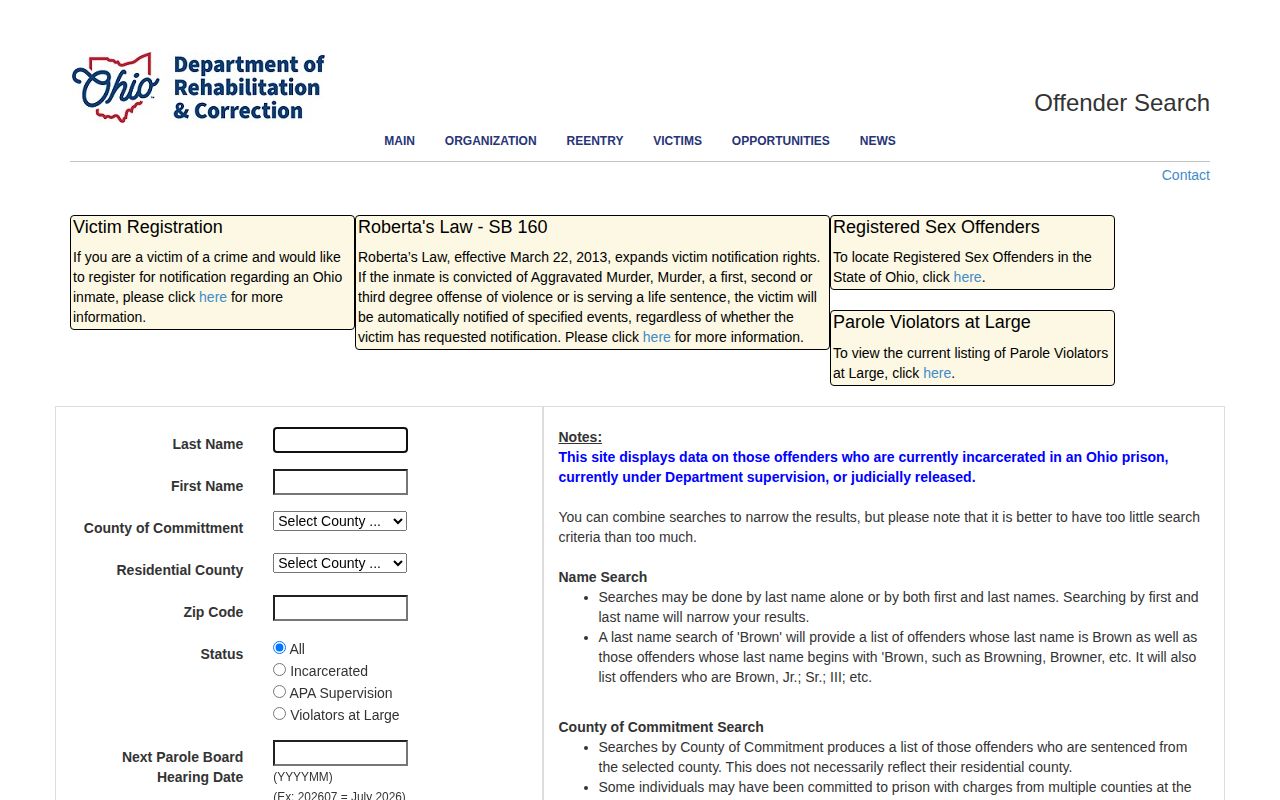
The screenshot shows why County of Commitment, status, and identity fields must be used together rather than reading one date as a final discharge.
Perry County Recent Release Search
No verified official Perry County, Ohio or SEORJ feed lists people released during a rolling 24-hour or 72-hour window. The JDS page is a current “New Inmate Roster.” Its run timestamp says when that page was generated, not how often it refreshes or how long data remains public. The roster has no release date, release reason, destination, released filter, or historical archive.
Do not use the similarly named Perry County, Tennessee portal. Localities such as Linden and McEwen identify that source as Tennessee. For Ohio, compare current SEORJ custody with the correct Perry court, VINE, ODRC when a prison transfer is possible, and a written request for the release sheet.
Note: A current booking photo and roster entry cannot be relabeled as a recent Perry County release record.
Perry Courts Explain Jail Releases
Perry’s court split gives post-roster evidence. Municipal Court handles countywide misdemeanor and traffic cases. Common Pleas handles felonies. A Municipal entry can show bond, recognizance, dismissal, sentence, probation, or a warrant. A Common Pleas file can show indictment, prison commitment, judicial release, and later supervision-related orders.
The Municipal Court search expressly warns that online data may lag by at least 24 hours and sometimes longer. The Common Pleas search supplies the felony path. A docket can explain the legal basis for release, but SEORJ confirms the physical time its custody ended.
The court record often remains searchable after the jail roster entry disappears. Even so, a docket timestamp is not a jail exit time. Read the filed judgment and compare it with the release event.
Perry County Release Supervision
State APA supervision and local probation are separate. ODRC’s APA Supervision filter covers parole, post-release control, and related Department supervision. Residential County=Perry searches the last reported county for APA or violator records. County of Commitment=Perry searches the sentencing county. Neither field should be used as a guaranteed present address.
Perry Municipal Court probation covers local court cases and may never produce an ODRC entry. Its published probation line is 740-342-5536. The sentencing entry and responsible office show whether supervision is local probation, state APA supervision, or a different court program. “Violator at Large” means an alleged absconder from APA supervision, not a new jail release.
Perry Release Reentry History
The 2019 systems map described referral paths involving the Six County Board and Allwell, Perry Behavioral Health, STAR Community Justice Center, and Hopewell-related jail reentry planning. It also said the Perry Reentry Alliance was inactive at that time. These are historical navigation leads, not current promises of service or eligibility.
A person leaving Perry-connected custody should confirm current services with the named provider or supervising agency. Release from jail does not by itself enroll someone in a program. Current court conditions, APA instructions, and provider rules control.
Perry Release Alerts and Federal Records
Ohio VINE can report county-jail and state custody events. Search one person by name or ID, match the supplying facility, and read the event. A SEORJ “released” event confirms that SEORJ reported departure from its custody. It does not rule out a transfer, other hold, later arrest, or supervision. The Ohio Attorney General cautions users not to rely on VINE alone.
Federal systems remain separate. The BOP Inmate Locator may show a past release date, which means the person left BOP custody as of that date. ICE’s locator covers current detainees and a limited recent-release period. The U.S. Marshals Service has no public name locator, so the federal docket and receiving custodian are the better route. No federal prison or verified ICE-contract facility was found in Perry County.
Perry Release Status by System
Each portal has a defined scope. Use a current roster to confirm current displayed custody, then move to the release or receiving-system record when that display ends.
| System | Still in custody | Released or moved |
|---|---|---|
| SEORJ | Current JDS roster entry | SEORJ release record, VINE event, and Perry docket |
| ODRC | Incarcerated status | Released, APA Supervision, or judicial-release detail |
| Perry courts | Commitment, remand, or unresolved hold context | Bond, dismissal, sentence, or judicial-release order |
| BOP | Active federal location | Past release date or RELEASED location |
| ICE | Current locator result | Recent release result within official coverage limits |
Transfer is release from one system but continued custody in another. State supervision is release from prison but not discharge from all legal obligations. Precise wording protects that distinction.
Perry County Release Facilities
Perry’s map includes the regional jail, the sheriff’s transport and records role, a juvenile facility with restricted access, and out-of-county state and federal systems. These are not six interchangeable jails.
- Southeastern Ohio Regional Jail holds Perry-connected adults and records the jail departure.
- Perry County Sheriff’s Office provides arrest, transport, and secondary report-request routes, but SEORJ is the full-service jail.
- Multi-County Juvenile Facility is not part of an adult public released-inmate search; authorized access follows juvenile rules.
- ODRC institutions statewide receive qualifying prison commitments and publish state status through Offender Search.
- BOP institutions nationwide cover a federal prison term, not a county-only detention.
- ICE and USMS channels apply only when facts show immigration or federal pretrial custody.
Historic Junction City Prison closed in 1977. It is not a current Perry custody or release source. SEORJ opened in April 1998 as the five-county cooperative that shapes today’s adult jail search.